
Screen Printing vs Digital Printing for Textiles: Which Suits Your Pattern?
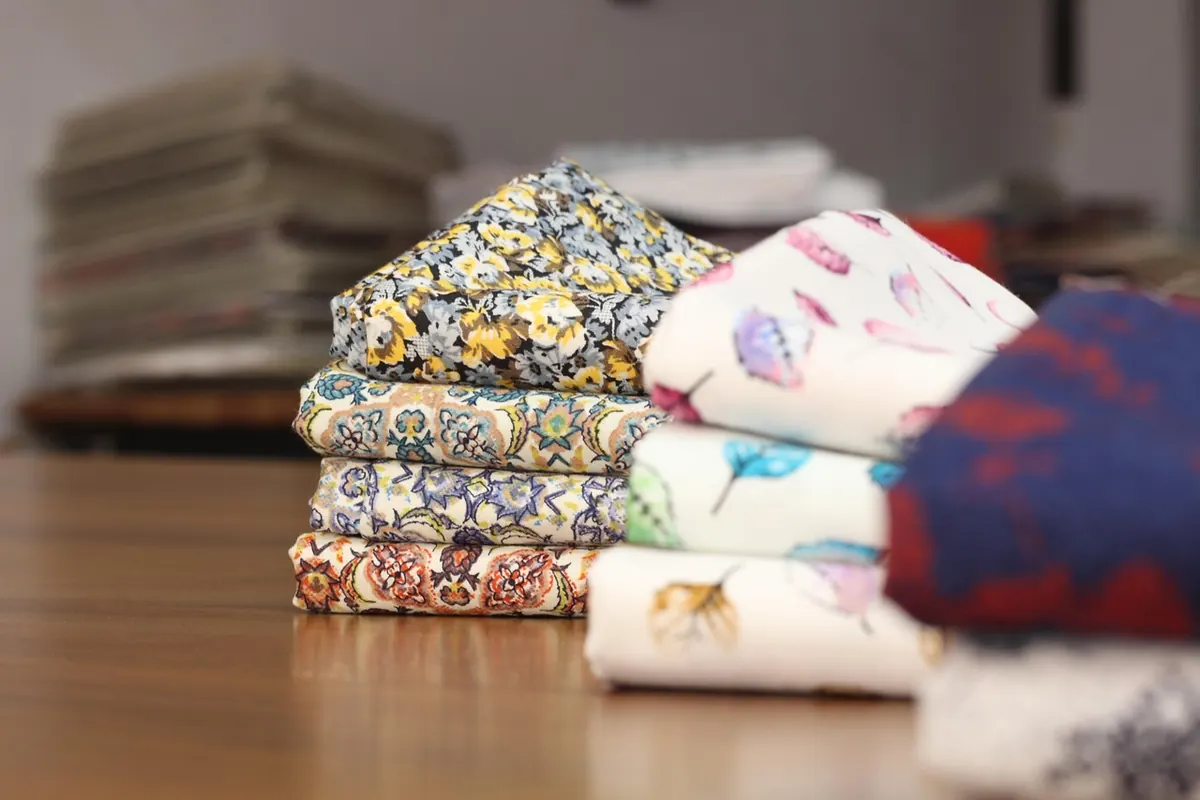
Choosing a printing method is a design decision as much as a production one. A three-colour geometric repeat on cotton canvas and a watercolour floral with a hundred soft tones will not travel the same route from sketch to shelf. Pick the wrong one and the mismatch shows up in three places: the unit price, the colour on the cloth, and the way the finished fabric drapes in the hand.
Here is how screen printing and digital printing actually differ on the things that decide most textile projects.
The Short Version: How Each Method Puts Ink on Cloth
Screen printing
Screen printing forces ink through a mesh, using a stencil created by exposing photographic emulsion to UV light. Every colour in your pattern needs its own screen, its own registration and its own pass through the press. Mesh count sets how much fine detail survives: a coarser mesh lays down a thick, opaque layer for bold shapes, while a fine mesh holds small text and tight linework. For fabric by the metre, rotary screen printing applies the same logic around a cylinder rather than a flat frame.
Ink choice changes the finished cloth as much as the artwork does. Plastisol sits on top of the fibre and gives strong, opaque colour. Water-based inks soak in and leave a softer handle. Discharge inks remove the base dye instead of covering it, which is how you get that faded, sun-bleached look on cotton.
Digital printing
Digital printing is inkjet for textiles. Your file goes straight to the printheads, so there is no screen to make and no setup to pay for. On garments this is direct-to-garment printing; on fabric rolls it is direct-to-fabric printing, usually with reactive inks on cotton and silk, pigment inks on blends, or disperse inks on polyester. Colour comes from a CMYK ink set plus a few extras, which means a gradient, a photographic detail or a twenty-colour pattern costs the same to print as two.
The trade-off sits in the chemistry. Reactive inks need steaming and washing to fix properly, pigment inks need heat curing, and dark garments usually need a pre-treatment and a white underbase, both of which affect the final feel.
Cost: Setup Charges Versus Per-Piece Price
Screen printing front-loads cost into preparation: making screens, mixing inks, setting registration and running test prints. Those charges apply per colour, per design. Once the press is running well, the cost of each additional piece falls quickly. Screen printing rewards volume and punishes fiddly palettes.
Digital printing reverses the shape of the invoice. There is no setup, so your first print costs roughly what your hundredth costs, but the per-unit price stays stubbornly high no matter how many you order. Nothing gets cheaper as you scale, which is why digital is rarely the answer for a long run of a simple two-colour design.
When you ask for quotes, request totals at three quantities — perhaps 25, 100 and 500 pieces — rather than comparing unit prices in isolation. The crossover point where screen becomes cheaper depends on your colour count, so a four-colour pattern will cross over at a smaller quantity than a twelve-colour one. Remember to include the cost of strike-offs and spoilage in your sums; both methods produce rejects.
Colour Accuracy, Detail and Repeat Size
Screen printing can hit a precise spot colour because someone mixes that ink by hand and you approve a physical swatch. If your pattern needs a brand colour matched exactly, or a clean flat tone across a large area, screen is the more dependable route.
Digital printing works within a printable colour gamut. Very bright neons and a few saturated tones may fall outside it, and the printer will substitute the nearest achievable colour. Results also shift between fabric batches and pre-treatment runs, so consistent colour management matters: ask your printer how they profile their cloth and whether they keep profiles for repeat orders. Check proofs under proper daylight-balanced lighting rather than beside a window on a cloudy afternoon.
Repeat size is another divider. Rotary screens are limited by cylinder circumference, which constrains how large a seamless repeat can be. Digital printing handles oversized repeats and engineered placements — a border print, a placed motif, a panel layout — far more freely.
Minimum Order Quantities and the Sampling Loop
Because of the setup, many screen printers set minimums per design and colourway, or accept small runs at a painful unit price. Digital printing can start at a single piece, which suits sample yardage, cushions, limited collections and made-to-order products.
A sensible sampling sequence looks like this:
- Print a digital strike-off first to check scale, placement and how the repeat reads on the actual cloth.
- Once the artwork is settled, request a screen strike-off in the production ink and mesh if you are heading for volume.
- Wash and wear the sample before you commit. Rub it, stretch it, run it through a normal cycle.
- Confirm which cloth the quote is based on, since changing base fabric can alter colour and hand.
Hand-Feel, Durability and Your Chosen Cloth
Plastisol sits on the surface, so a heavy print on jersey feels noticeably thick and can crack if it is under-cured or stretched hard. Water-based and discharge prints feel close to bare cloth. Digital printing varies enormously: reactive inks on cotton give a soft, dyed-in finish, while direct-to-garment printing on dark cotton can feel slightly rubbery because of the underbase. Sublimation on polyester leaves no hand at all, but only works on light-coloured polyester.
Durability comes down to curing and care more than the method itself. Ask your printer what curing they use, follow their wash guidance, and print care labels that match. Washing inside out in cooler water and avoiding harsh detergent will keep most prints looking better for longer.
Which Method Suits Your Pattern?
- Screen printing: two to four flat colours, bold shapes, 100+ pieces, cotton totes and sweatshirts, metallic or puff effects.
- Digital printing: gradients, photographic imagery, twelve or more tones, short runs, samples, print-on-demand.
- Want a soft hand on dark cotton? Look at water-based or discharge screen printing, or reactive digital.
- Printing polyester performance fabric? Sublimation or disperse digital is usually the practical answer.
- Need to reorder in six months? Screen holds a mixed spot colour more predictably; digital needs the same cloth and a maintained profile.
A Practical Way to Order Your First Run
Lock the repeat and count your colours before you talk to anyone. Fewer than five flat colours plus a reasonable quantity points to screen; anything photographic, tonal or tiny points to digital. Decide on the cloth next, because it constrains everything else, then gather strike-offs and quotes together rather than treating them as separate errands.
One more thing worth planning for: screen printing involves solvents, emulsion chemicals and wash water, and reactive digital printing produces dye-laden wastewater. Ask your printer how they ventilate the workshop, handle PPE and dispose of waste, and check what your local regulations require if you are printing in-house. The same goes for care instructions and any fibre-content claims on your labels — worth a quick check with your printer or a trading standards adviser before you print a thousand of them.
Get those decisions settled early and the printing method stops being a gamble. It becomes a straightforward consequence of the pattern you have already made.
Photo: Texworks / Pixabay